Understanding SQLAlchemy Engine and Connection Objects

Understanding SQLAlchemy Engine and Connection Objects

Best practices for SQLAlchemy engine and connection objects include using context managers for automatic connection cleanup, batch processing with transaction scopes for atomic operations, tuning connection pool settings, handling exceptions for stability, and separating database logic from application code for maintainability and performance optimization.
Understanding socket.getprotobyname for Protocol Information

Understanding socket.getprotobyname for Protocol Information

Common socket programming pitfalls include improper socket state handling, neglecting socket options like timeouts, and failing to close sockets, leading to resource leaks. Address network latency with retry logic, use detailed logging for troubleshooting, and test across platforms for compatibility and reliability.
Working with asyncio Subprocesses for External Commands

Working with asyncio Subprocesses for External Commands

Minimizing latency in subprocess communication involves reducing buffering and ensuring prompt data flow between processes. Use the -u flag in Python to disable buffering, adopt small chunk reads/writes, and implement asyncio for non-blocking operations. Efficient handling of stdout and stderr enhances responsiveness and reduces delays in data processing.
Python and Hashing Algorithms

Python and Hashing Algorithms

Python’s randomized hash seed, introduced in version 3.3, prevents denial-of-service attacks by varying hash values between sessions. Custom hash functions should mix bits and avoid collisions. Python’s built-in hash() benefits from cryptographic research, making it a reliable choice for immutable types.
Advanced Data Visualization Techniques in Matplotlib

Advanced Data Visualization Techniques in Matplotlib

Interactive visualizations in Python using ipywidgets with Matplotlib or Plotly enable dynamic data exploration through sliders, dropdowns, and buttons. These tools support adjustable parameters for 2D and 3D plots, customizable layouts with VBox and HBox, and seamless integration within Jupyter notebooks for enhanced analysis.
Data Preprocessing with Keras Utilities

Data Preprocessing with Keras Utilities

Data augmentation enhances machine learning model robustness, particularly in computer vision. Keras' `ImageDataGenerator` allows real-time transformations like rotation, zoom, and brightness adjustments, improving generalization and reducing overfitting. Efficient data pipelines using Keras and TensorFlow optimize training performance while applying augmentations on-the-fly.
Building Scalable Applications with Django

Building Scalable Applications with Django

Database interactions under load highlight the impact of design choices. Minimizing queries per request, using batching techniques, and leveraging prepared statements enhance performance. Connection pooling, short transactions, and read replicas improve scalability. Caching layers and regular query execution plan analysis further optimize database efficiency.
Working with Cursors in MongoDB Queries with Pymongo

Working with Cursors in MongoDB Queries with Pymongo

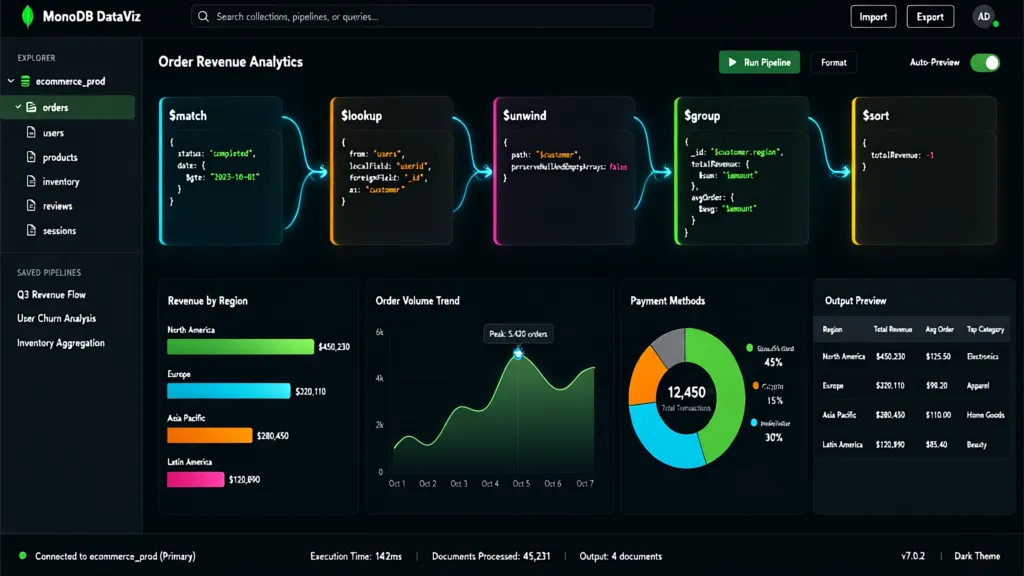
Efficient data handling in MongoDB is vital for application performance. Control memory usage by utilizing limit() and batch_size() for cursor retrieval. Properly close cursors to prevent resource leaks. Use projection to minimize data transfer and apply aggregation frameworks for bulk operations. Monitor query performance to optimize operations and scale effectively.