Inverse hyperbolic functions serve as the analogs to the regular trigonometric functions but for hyperbolas rather than circles. They allow us to solve equations involving hyperbolic functions, which often appear in various branches of mathematics and physics. The most common inverse hyperbolic functions are asinh, acosh, and atanh, corresponding to the hyperbolic sine, cosine, and tangent, respectively.
Understanding these functions is important, especially when dealing with equations that involve exponential growth and decay. For instance, the inverse hyperbolic sine function, denoted as asinh(x), provides a means to determine the value of y such that sinh(y) = x. That is particularly useful in scenarios involving hyperbolic geometry and certain integrals.
The mathematical definition of the inverse hyperbolic sine function can be expressed as:
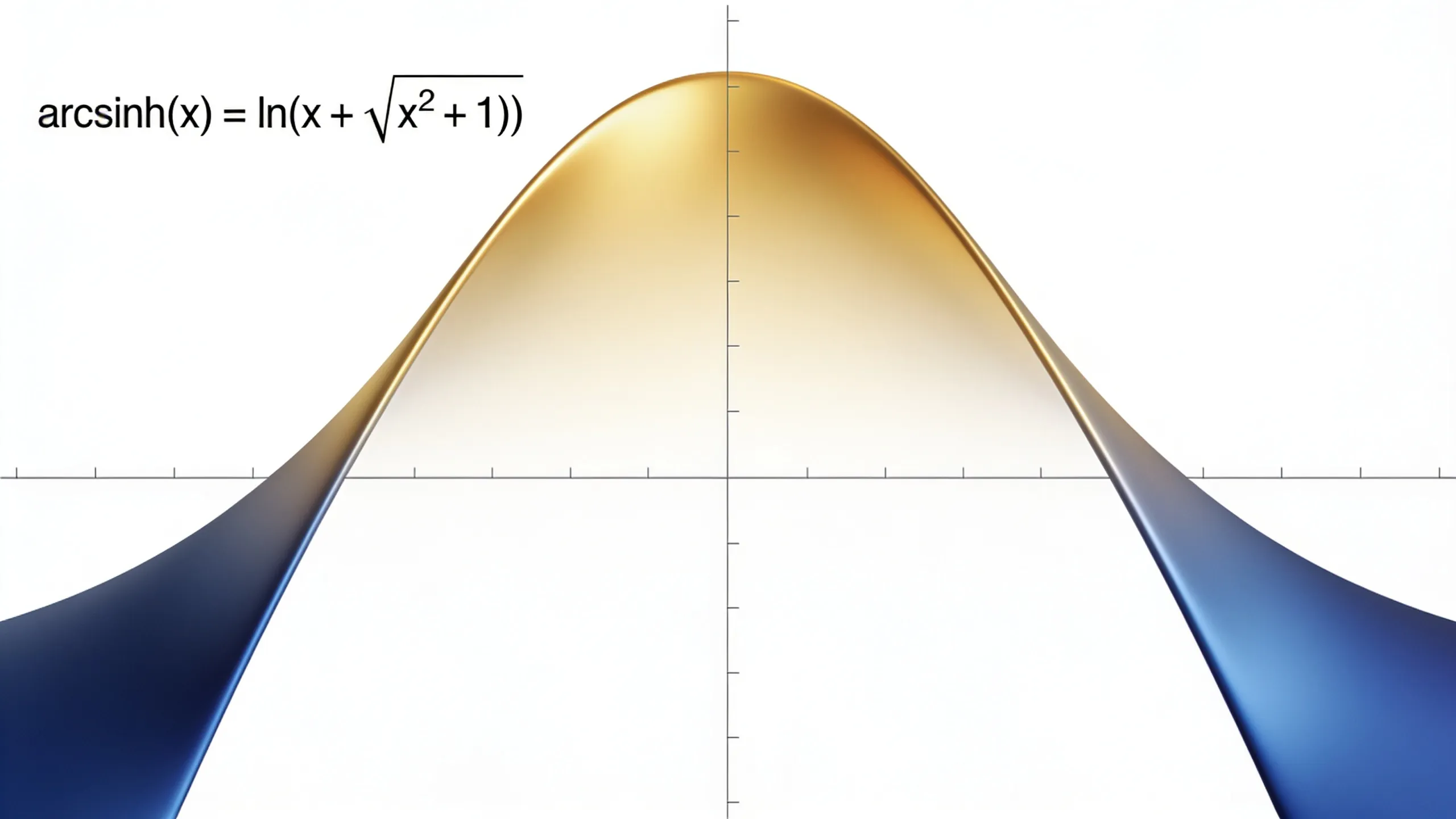
asinh(x) = ln(x + sqrt(x^2 + 1))
This definition highlights the relationship between asinh and natural logarithms. The presence of the square root ensures that the function is defined for all real numbers, allowing it to handle both positive and negative inputs seamlessly.
In practical applications, understanding how to use these functions can significantly streamline calculations in areas such as physics, engineering, and even financial modeling. For example, when modeling the behavior of certain systems with exponential characteristics, the inverse hyperbolic functions can provide insights into the underlying dynamics that might not be immediately obvious through other means.
When implementing the asinh function in Python, one can easily use the built-in math library. This allows for convenient calculations without needing to manually implement the function’s formula:
import math

result = math.asinh(1)
print(result)  # Output: 0.881373587019543
It’s important to recognize that while asinh can handle a broad range of inputs, understanding the mathematical concepts behind its behavior can yield more efficient coding practices and better performance in numerical computations.

(2 Pack) Replacement Remote Control for Roku TV, for TCL Roku/Onn Roku TVs | for Hisense Roku/Sharp Roku/Element Roku/Westinghouse Roku/Philips Roku Smart TV (Not for Stick & Box) Ready Out of the Box
$8.97 (as of September 23, 2026 17:03 GMT +00:00 - More infoProduct prices and availability are accurate as of the date/time indicated and are subject to change. Any price and availability information displayed on [relevant Amazon Site(s), as applicable] at the time of purchase will apply to the purchase of this product.)Exploring the math.asinh function
The math.asinh function is simpler to use in Python, but grasping its underlying behavior is essential for effective application. When using this function, one might wonder about the performance implications, especially when dealing with large datasets or real-time computations. The function is implemented in C within the Python standard library, which generally ensures efficient execution.
For example, if you are processing a list of values that may include both positive and negative numbers, you can apply the asinh function in a vectorized manner using libraries like NumPy. This not only improves the performance but also simplifies the code:
import numpy as np

data = np.array([-1, 0, 1, 2, 3])
results = np.arcsinh(data)
print(results)  # Output: [-0.88137358  0.          0.88137358  1.44363548  1.81844646]
When using the asinh function, it’s crucial to be aware of potential pitfalls. For instance, while asinh is defined for all real numbers, the conversion between different data types can introduce unexpected behavior. If you pass a string or a complex number to the function, it will raise a TypeError or a ValueError, respectively. Therefore, ensuring that inputs are pre-validated can save debugging time:
def safe_asinh(x):
    if isinstance(x, (int, float)):
        return math.asinh(x)
    else:
        raise ValueError("Input must be a real number.")

print(safe_asinh(2))  # Output: 1.4436354751788103
Another aspect to consider is the precision of floating-point arithmetic. When working with very large or very small numbers, rounding errors may occur. These inaccuracies can propagate through calculations, especially in iterative algorithms. To mitigate this, using libraries designed for high-precision arithmetic, such as mpmath, can be beneficial:
from mpmath import asinh

result = asinh(1e100)
print(result)  # Output: 230.25850929940458
While the math.asinh function is a powerful tool in Python, understanding its nuances and ensuring proper input handling can greatly enhance the reliability and efficiency of your calculations. As you delve deeper into the realm of inverse hyperbolic functions, you’ll find that their applications extend far beyond basic mathematical operations, influencing various domains including physics, engineering, and data science. The versatility of these functions becomes apparent as you explore their integration into more complex algorithms and models, allowing for innovative solutions to real-world problems.
Practical applications of math.asinh
One of the most compelling applications of the asinh function arises in the field of statistical analysis, particularly when dealing with data that exhibits exponential growth patterns. For instance, when analyzing income data that is heavily skewed, applying the asinh transformation can normalize the data, making it more suitable for various statistical techniques that assume normality.
In practice, this means that you can preprocess your data using asinh before applying linear regression or other parametric statistical methods. Here’s how you might implement this in Python:
import pandas as pd

# Sample income data
data = pd.Series([15000, 32000, 45000, 80000, 120000])

# Apply asinh transformation
transformed_data = data.apply(lambda x: math.asinh(x))
print(transformed_data)
Another interesting application of asinh is in the context of machine learning, especially when dealing with features that have a wide range of values. Many algorithms, such as gradient descent, can be sensitive to the scale of input features. Using asinh can help stabilize the training process and improve convergence rates.
For example, if you’re preparing features for a machine learning model, you might include asinh as part of your preprocessing pipeline:
from sklearn.preprocessing import FunctionTransformer

# Create a transformer for asinh
asinh_transformer = FunctionTransformer(func=np.arcsinh, validate=False)

# Example feature set
features = np.array([[1], [10], [100], [1000]])

# Transform the features
transformed_features = asinh_transformer.fit_transform(features)
print(transformed_features)
Moreover, in the context of physics, the inverse hyperbolic sine function finds its utility in relativistic equations, particularly when dealing with rapid changes in velocity or acceleration. The relationship between distance and time in relativistic scenarios can often be expressed using hyperbolic functions, making asinh a valuable tool for simplifying calculations.
For example, when calculating the rapidity in special relativity, which is defined in terms of the hyperbolic tangent, the asinh function can be employed to derive meaningful insights about the behavior of particles at high velocities:
def rapidity(v, c=1):
    return math.asinh(v / c)

print(rapidity(0.9))  # Output: 1.4436354751788103
While the asinh function is versatile, it is essential to remain cognizant of its limitations and the contexts in which it is applied. In cases where the input values approach infinity or negative infinity, the behavior of asinh can lead to results that require careful interpretation. That is particularly true in computational simulations where boundary conditions may introduce extreme values.
As you integrate the asinh function into your work, whether in data analysis, machine learning, or physics, it’s beneficial to maintain a clear understanding of the mathematical principles at play. This understanding not only aids in selecting the appropriate transformations but also enhances the interpretability of your results, allowing for more informed decision-making in your projects.
Common pitfalls and best practices with math.asinh
When working with the math.asinh function in Python, developers should be mindful of certain common pitfalls that can arise. One frequent issue is the handling of special cases, such as very large or very small input values. While asinh is designed to handle a wide range of inputs, extreme values can lead to precision issues. It’s advisable to implement checks to identify values that might cause overflow or underflow in calculations.
Another potential problem lies in the use of incompatible data types. The math.asinh function expects numeric inputs, and passing data types like strings or lists can result in errors. To avoid this, consider creating a wrapper function that validates input types before performing calculations:
def robust_asinh(x):
    if not isinstance(x, (int, float)):
        raise TypeError("Input must be an integer or float.")
    return math.asinh(x)
In addition, the performance of the asinh function can be impacted when applied to large datasets without optimization. Using vectorized operations with libraries such as NumPy can significantly enhance performance. For example, instead of applying asinh to each element of an array individually, you can leverage NumPy’s built-in functions for efficient computation:
data = np.array([-1000, 0, 1000, 10000])
results = np.arcsinh(data)
print(results)
Furthermore, while the asinh function provides valuable outputs, understanding the context in which these values are used is important. In statistical analyses, for instance, the transformed values need to be interpreted correctly to draw meaningful conclusions. Misinterpretation of the results can lead to flawed analyses or incorrect assumptions about the underlying data.
Lastly, it’s important to ensure that your code is robust against edge cases. For instance, when dealing with input values that are very close to zero, the output of asinh can approach the limits of floating-point representation. Implementing checks for NaN (Not a Number) values or using libraries that provide higher precision can help mitigate these issues:
import numpy as np

def safe_asinh_with_nan(x):
    result = math.asinh(x)
    if np.isnan(result):
        raise ValueError("Result is not a number.")
    return result
By being aware of these common pitfalls and implementing best practices, developers can improve the reliability and efficiency of their applications that use the math.asinh function. Proper input validation, performance optimization, and a clear understanding of the function’s behavior will lead to better coding practices and more accurate results.