
Encryption is an important aspect of data security, and understanding the difference between symmetric and asymmetric encryption algorithms can help developers choose the right approach for their applications.
Symmetric encryption uses a single key for both encryption and decryption. This means that both the sender and receiver must have access to the same key, which can pose a challenge in securely sharing the key. Common symmetric encryption algorithms include AES (Advanced Encryption Standard) and DES (Data Encryption Standard).
from Crypto.Cipher import AES
from Crypto.Util.Padding import pad, unpad
from Crypto.Random import get_random_bytes

key = get_random_bytes(16)  # AES key must be either 16, 24, or 32 bytes
cipher = AES.new(key, AES.MODE_CBC)
plaintext = b'This is a secret message.'
ciphertext = cipher.encrypt(pad(plaintext, AES.block_size))
In contrast, asymmetric encryption uses a pair of keys: a public key and a private key. The public key is used for encryption, while the private key is used for decryption. This allows for secure key exchange since the public key can be shared openly, while the private key remains confidential. RSA (Rivest-Shamir-Adleman) is one of the most widely used asymmetric encryption algorithms.
from Crypto.PublicKey import RSA
from Crypto.Cipher import PKCS1_OAEP

key = RSA.generate(2048)
public_key = key.publickey()
cipher = PKCS1_OAEP.new(public_key)
plaintext = b'This is a secret message.'
ciphertext = cipher.encrypt(plaintext)
Both types of encryption have their use cases. Symmetric encryption is typically faster and more efficient for encrypting large amounts of data, while asymmetric encryption is often used for secure key exchange and digital signatures. Understanding these differences helps in designing secure systems that meet specific requirements.
When implementing encryption workflows, it is essential to take into consideration the sensitivity of the data, the performance requirements, and the potential risks associated with key management. For example, using symmetric encryption for bulk data storage, while using asymmetric encryption for sharing keys securely, can be an effective strategy.
Another important aspect to consider is the choice of algorithms. Not all encryption algorithms are created equal, and some may be more vulnerable to attacks than others. AES is widely regarded as secure when implemented correctly, while older algorithms like DES are no longer considered safe for use.
As you dive deeper into encryption practices, you’ll encounter various libraries and frameworks that simplify the implementation process. Python, for instance, has several libraries that provide robust encryption functionalities.
from Crypto.Cipher import AES
from Crypto.Util.Padding import pad, unpad
from Crypto.Random import get_random_bytes

def encrypt_message(message, key):
    cipher = AES.new(key, AES.MODE_CBC)
    ciphertext = cipher.encrypt(pad(message.encode(), AES.block_size))
    return cipher.iv, ciphertext

key = get_random_bytes(16)
iv, encrypted_message = encrypt_message('Hello, World!', key)
By using these libraries, you can focus on higher-level design rather than getting bogged down in the complexities of cryptographic algorithms. However, it’s important to stay updated on best practices and potential vulnerabilities, as the field of cryptography is ever-evolving.
Incorporating encryption into your applications not only enhances security but also builds trust with users, ensuring that sensitive information remains protected from unauthorized access. As you implement these algorithms, remember to keep an eye on performance and usability, as these elements are just as crucial to the user experience.
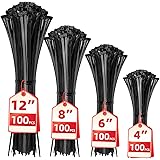
Cable Zip Ties,400 Pack Black Assorted Sizes 12+8+6+4 Inch,Multi-Purpose Self-Locking Nylon Cable Cord Management,Plastic Wire Ties for Home,Office,Garden,Workshop. By HAVE ME TD
$6.99 (as of October 24, 2026 20:23 GMT +00:00 - More infoProduct prices and availability are accurate as of the date/time indicated and are subject to change. Any price and availability information displayed on [relevant Amazon Site(s), as applicable] at the time of purchase will apply to the purchase of this product.)Implementing encryption workflows with Python libraries
To implement encryption workflows effectively using Python, developers can use libraries such as PyCryptodome, which offers a wide range of cryptographic functions. Here’s an example of how to implement both symmetric and asymmetric encryption in a single workflow.
from Crypto.Cipher import AES
from Crypto.PublicKey import RSA
from Crypto.Cipher import PKCS1_OAEP
from Crypto.Util.Padding import pad, unpad
from Crypto.Random import get_random_bytes

# Symmetric encryption function
def encrypt_symmetric(message, key):
    cipher = AES.new(key, AES.MODE_CBC)
    ciphertext = cipher.encrypt(pad(message.encode(), AES.block_size))
    return cipher.iv, ciphertext

# Asymmetric encryption function
def encrypt_asymmetric(message, public_key):
    cipher = PKCS1_OAEP.new(public_key)
    ciphertext = cipher.encrypt(message.encode())
    return ciphertext

# Generate a key for symmetric encryption
symmetric_key = get_random_bytes(16)

# Generate RSA keys for asymmetric encryption
rsa_key = RSA.generate(2048)
public_key = rsa_key.publickey()

# Encrypt a message symmetrically
iv, encrypted_message = encrypt_symmetric('Hello, Symmetric World!', symmetric_key)

# Encrypt a message asymmetrically
encrypted_asymmetric_message = encrypt_asymmetric('Hello, Asymmetric World!', public_key)
This code snippet demonstrates how to create both symmetric and asymmetric encryption functions. The encrypt_symmetric function uses AES to encrypt a message, while the encrypt_asymmetric function uses RSA. This allows for a versatile approach where you can choose the appropriate method based on the context of your application.
When it comes to decryption, you can implement similar functions to reverse the process. Here’s how you can handle both symmetric and asymmetric decryption:
# Symmetric decryption function
def decrypt_symmetric(iv, ciphertext, key):
    cipher = AES.new(key, AES.MODE_CBC, iv)
    plaintext = unpad(cipher.decrypt(ciphertext), AES.block_size)
    return plaintext.decode()

# Asymmetric decryption function
def decrypt_asymmetric(ciphertext, private_key):
    cipher = PKCS1_OAEP.new(private_key)
    plaintext = cipher.decrypt(ciphertext)
    return plaintext.decode()

# Decrypt the symmetric message
decrypted_message = decrypt_symmetric(iv, encrypted_message, symmetric_key)

# Decrypt the asymmetric message
decrypted_asymmetric_message = decrypt_asymmetric(encrypted_asymmetric_message, rsa_key)
The decrypt_symmetric function takes the initialization vector (IV), the ciphertext, and the symmetric key to return the original plaintext. Similarly, the decrypt_asymmetric function uses the private key to decrypt the asymmetric ciphertext. This dual approach allows developers to manage various data protection needs with ease.
As you design your encryption workflows, consider the overall architecture of your application. Encryption should be seamlessly integrated into data handling processes, ensuring that sensitive data is encrypted before storing or transmitting. Additionally, always validate input data and handle exceptions properly to maintain the integrity of your encryption logic.
Remember that performance can vary between symmetric and asymmetric encryption. While symmetric encryption is generally faster and suitable for large datasets, asymmetric encryption is more computationally intensive. Therefore, it’s common to use asymmetric encryption for securely exchanging symmetric keys, which are then used for encrypting larger messages.