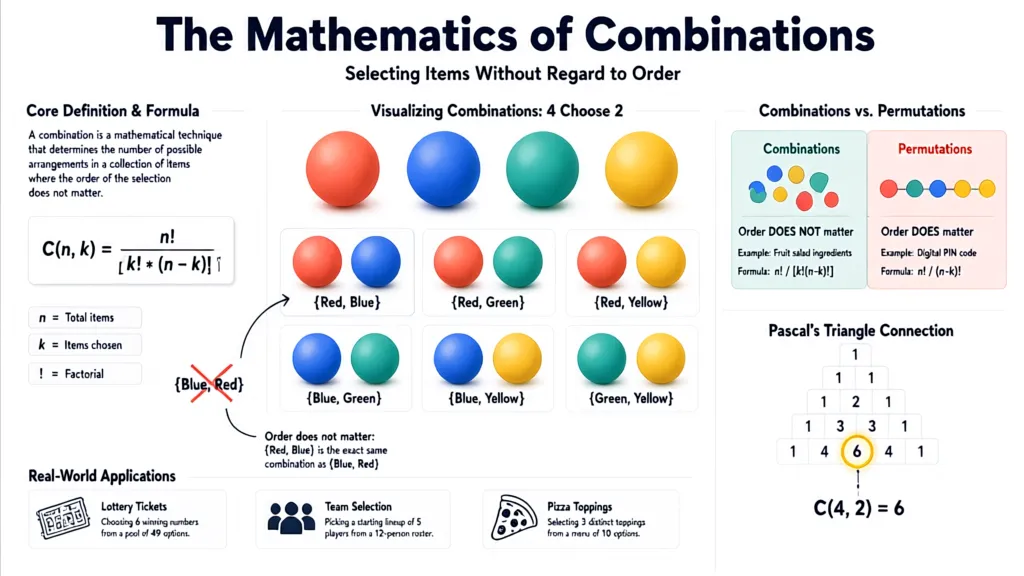
Combinations represent a fundamental concept in combinatorial mathematics, focusing on selecting items from a larger set without regard to the order of selection. Unlike permutations, which consider the arrangement of items, combinations emphasize the grouping itself. This distinction is vital when solving problems where the order does not influence the outcome.
For example, if you’re tasked with forming a committee from a pool of candidates, the order in which you select members is irrelevant. The mathematical representation of combinations is often denoted as C(n, k), where n is the total number of items, and k is the number of items to choose.
Understanding combinations can significantly enhance your ability to solve real-world problems, such as calculating odds in games, determining possible outcomes in experiments, or optimizing resource allocation in projects. This significance extends beyond theoretical applications, permeating fields like statistics, finance, and computer science.
To grasp combinations more deeply, consider the classic example of a lottery, where players select a set of numbers from a larger pool. The total number of ways to choose those numbers without concern for order is a combination problem.
def calculate_combinations(n, k):
    if k > n:
        return 0
    if k == 0 or k == n:
        return 1
    numerator = 1
    denominator = 1
    for i in range(k):
        numerator *= (n - i)
        denominator *= (i + 1)
    return numerator // denominator

print(calculate_combinations(5, 3))  # Output: 10
This simple Python function calculates combinations using a simpler approach, iterating through the necessary multiplicative factors to derive the result. The function checks for edge cases, ensuring that it handles scenarios where k is greater than n or where k is 0 or equal to n accurately.
As one delves into more complex scenarios, the importance of understanding combinations becomes even more pronounced. For instance, in data analysis, determining subsets of data for testing hypotheses requires a solid grasp of how to count combinations effectively. Misapplying these concepts can lead to significant errors in results and conclusions.
Moreover, combinations play an important role in algorithms, especially in generating subsets of data structures. When designing algorithms that require grouping elements, using combinations not only simplifies the logic but also optimizes performance by reducing redundancy in calculations.
from itertools import combinations

data = [1, 2, 3, 4]
for combo in combinations(data, 2):
    print(combo)
The example above utilizes Python’s itertools library to generate combinations of a given data set. This approach allows programmers to efficiently explore all possible groupings, making it invaluable for scenarios like testing, simulations, or even building game mechanics where specific combinations yield different results.
As you deepen your understanding of combinations, it becomes essential to avoid common pitfalls. One such issue is neglecting the constraints of the problem, which can lead to overcounting or undercounting potential combinations. It’s crucial to always clarify the parameters before diving into calculations, ensuring that your approach aligns with the specific requirements of the task.
Another frequent mistake is misapplying the combination formula, particularly in scenarios involving repetitions or restrictions. Familiarizing yourself with the nuances of these variations can save time and prevent costly errors. For instance, understanding the difference between combinations with repetitions and those without can radically change the outcome of your calculations.

Now retrieving an image set.
Apple 2026 MacBook Air 15-inch Laptop with M5 chip: Built for AI, 15.3-inch Liquid Retina Display, 16GB Unified Memory, 512GB SSD, 12MP Center Stage Camera, Touch ID, Wi-Fi 7; Sky Blue
$1,499.00 (as of September 14, 2026 11:16 GMT +00:00 - More infoProduct prices and availability are accurate as of the date/time indicated and are subject to change. Any price and availability information displayed on [relevant Amazon Site(s), as applicable] at the time of purchase will apply to the purchase of this product.)Using math.comb for efficient calculations
Python 3.8 introduced the math.comb function, which allows developers to compute combinations directly and efficiently. This built-in function abstracts away the complexity of calculating combinations manually, providing a simpler interface for users. The syntax is simple: math.comb(n, k), where n is the total number of items, and k is the number of items to choose.
import math

# Calculate combinations using math.comb
result = math.comb(5, 3)
print(result)  # Output: 10
This implementation leverages optimized algorithms under the hood, making it faster and less error-prone than manual calculations. Using math.comb not only improves code readability but also enhances performance, especially for larger values of n and k. It is worth noting that the function automatically handles edge cases, such as when k is greater than n, returning 0 in such cases.
When using math.comb, it’s essential to recognize its limitations. The function is designed for non-negative integers, and passing invalid arguments can lead to exceptions. Therefore, validating input before invoking the function can safeguard against runtime errors.
def safe_comb(n, k):
    if n < 0 or k < 0:
        raise ValueError("n and k must be non-negative integers")
    return math.comb(n, k)

print(safe_comb(5, 3))  # Output: 10
Incorporating this validation ensures that your code remains robust and handles unexpected scenarios gracefully. Moreover, understanding the implications of large values of n very important, as factorial growth can lead to performance issues. In such cases, the efficiency of math.comb becomes particularly beneficial.
As you implement combinations in your projects, it is important to consider the context in which you are applying them. For instance, in statistical analyses, the choice of combinations can significantly affect the results of hypothesis testing and confidence intervals. Miscalculating combinations in these scenarios can lead to incorrect interpretations of data.
Another aspect to keep in mind is the distinction between combinations and permutations. While combinations focus solely on selection, permutations account for the arrangement of those selections. Understanding when to apply each concept is vital for accurate calculations and problem-solving.
from itertools import permutations

data = [1, 2, 3]
for perm in permutations(data, 2):
    print(perm)
This example demonstrates how to generate permutations of a list, showcasing the order-sensitive nature of permutations compared to combinations. Misapplying these concepts can lead to inflated complexity in your algorithms and incorrect results, particularly in combinatorial problems.
As you refine your skills in combinatorial mathematics, be aware of common pitfalls that can arise during calculations. One such issue is the misinterpretation of the problem's requirements, leading to incorrect application of the combination formula. Always ensure you have a clear understanding of whether order matters in your selection process.
Another common mistake is overlooking constraints such as maximum limits on selections or specific conditions that affect the choice of combinations. These constraints can significantly alter the number of valid combinations, and failing to account for them can result in erroneous outputs. Thoroughly analyzing the problem statement and clarifying any ambiguities will help mitigate these risks.
Common pitfalls and best practices in combination calculations
Combinations represent a fundamental concept in combinatorial mathematics, focusing on selecting items from a larger set without regard to the order of selection. Unlike permutations, which consider the arrangement of items, combinations emphasize the grouping itself. This distinction is vital when solving problems where the order does not influence the outcome.
For example, if you are tasked with forming a committee from a pool of candidates, the order in which you select members is irrelevant. The mathematical representation of combinations is often denoted as C(n, k), where n is the total number of items, and k is the number of items to choose.
Understanding combinations can significantly enhance your ability to solve real-world problems, such as calculating odds in games, determining possible outcomes in experiments, or optimizing resource allocation in projects. This significance extends beyond theoretical applications, permeating fields like statistics, finance, and computer science.
To grasp combinations more deeply, consider the classic example of a lottery, where players select a set of numbers from a larger pool. The total number of ways to choose those numbers without concern for order is a combination problem.
def calculate_combinations(n, k):
    if k > n:
        return 0
    if k == 0 or k == n:
        return 1
    numerator = 1
    denominator = 1
    for i in range(k):
        numerator *= (n - i)
        denominator *= (i + 1)
    return numerator // denominator

print(calculate_combinations(5, 3))  # Output: 10
This simple Python function calculates combinations using a simpler approach, iterating through the necessary multiplicative factors to derive the result. The function checks for edge cases, ensuring that it handles scenarios where k is greater than n or where k is 0 or equal to n accurately.
As one delves into more complex scenarios, the importance of understanding combinations becomes even more pronounced. For instance, in data analysis, determining subsets of data for testing hypotheses requires a solid grasp of how to count combinations effectively. Misapplying these concepts can lead to significant errors in results and conclusions.
Moreover, combinations play an important role in algorithms, especially in generating subsets of data structures. When designing algorithms that require grouping elements, using combinations not only simplifies the logic but also optimizes performance by reducing redundancy in calculations.
from itertools import combinations

data = [1, 2, 3, 4]
for combo in combinations(data, 2):
    print(combo)
The example above utilizes Python's itertools library to generate combinations of a given data set. This approach allows programmers to efficiently explore all possible groupings, making it invaluable for scenarios like testing, simulations, or even building game mechanics where specific combinations yield different results.
As you deepen your understanding of combinations, it becomes essential to avoid common pitfalls. One such issue is neglecting the constraints of the problem, which can lead to overcounting or undercounting potential combinations. It is crucial to always clarify the parameters before diving into calculations, ensuring that your approach aligns with the specific requirements of the task.
Another frequent mistake is misapplying the combination formula, particularly in scenarios involving repetitions or restrictions. Familiarizing yourself with the nuances of these variations can save time and prevent costly errors. For instance, understanding the difference between combinations with repetitions and those without can radically change the outcome of your calculations.
Python 3.8 introduced the math.comb function, which allows developers to compute combinations directly and efficiently. This built-in function abstracts away the complexity of calculating combinations manually, providing a simpler interface for users. The syntax is simple: math.comb(n, k), where n is the total number of items, and k is the number of items to choose.
import math

# Calculate combinations using math.comb
result = math.comb(5, 3)
print(result)  # Output: 10
This implementation leverages optimized algorithms under the hood, making it faster and less error-prone than manual calculations. Using math.comb not only improves code readability but also enhances performance, especially for larger values of n and k. It's worth noting that the function automatically handles edge cases, such as when k is greater than n, returning 0 in such cases.
When using math.comb, it is essential to recognize its limitations. The function is designed for non-negative integers, and passing invalid arguments can lead to exceptions. Therefore, validating input before invoking the function can safeguard against runtime errors.
def safe_comb(n, k):
    if n < 0 or k < 0:
        raise ValueError("n and k must be non-negative integers")
    return math.comb(n, k)

print(safe_comb(5, 3))  # Output: 10
Incorporating this validation ensures that your code remains robust and handles unexpected scenarios gracefully. Moreover, understanding the implications of large values of n very important, as factorial growth can lead to performance issues. In such cases, the efficiency of math.comb becomes particularly beneficial.
As you implement combinations in your projects, it's important to consider the context in which you are applying them. For instance, in statistical analyses, the choice of combinations can significantly affect the results of hypothesis testing and confidence intervals. Miscalculating combinations in these scenarios can lead to incorrect interpretations of data.
Another aspect to keep in mind is the distinction between combinations and permutations. While combinations focus solely on selection, permutations account for the arrangement of those selections. Understanding when to apply each concept is vital for accurate calculations and problem-solving.
from itertools import permutations

data = [1, 2, 3]
for perm in permutations(data, 2):
    print(perm)
This example demonstrates how to generate permutations of a list, showcasing the order-sensitive nature of permutations compared to combinations. Misapplying these concepts can lead to inflated complexity in your algorithms and incorrect results, particularly in combinatorial problems.
As you refine your skills in combinatorial mathematics, be aware of common pitfalls that can arise during calculations. One such issue is the misinterpretation of the problem's requirements, leading to incorrect application of the combination formula. Always ensure you have a clear understanding of whether order matters in your selection process.
Another common mistake is overlooking constraints such as maximum limits on selections or specific conditions that affect the choice of combinations. These constraints can significantly alter the number of valid combinations, and failing to account for them can result in erroneous outputs. Thoroughly analyzing the problem statement and clarifying any ambiguities will help mitigate these risks.