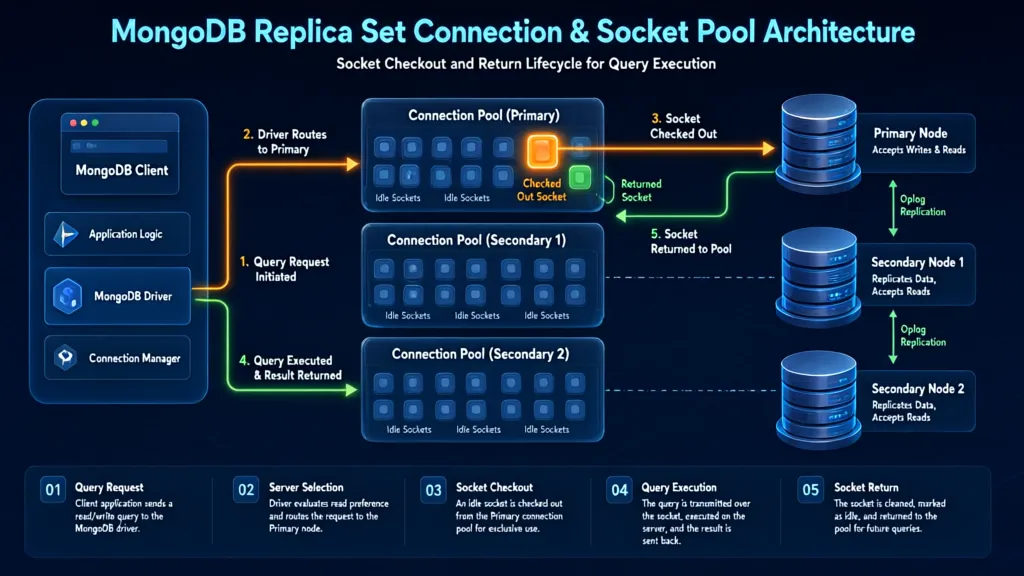
A MongoDB connection pool is not one shared bucket of sockets. A client maintains a separate pool for each server it may talk to, so a replica-set client can have pools for the primary and secondaries, plus monitoring connections used to discover topology changes. Application operations check out a socket from the pool associated with the selected server, send a command, then return the socket when the operation finishes.
In PyMongo, create one MongoClient per process and reuse it. Constructing a client for each request throws away pooling benefits and adds connection setup work. The client is thread-safe; after a fork, create a new client in the child process rather than inheriting the parent’s sockets.
from pymongo import MongoClient

client = MongoClient("mongodb://db1,db2,db3/?replicaSet=rs0")
collection = client.app.events

def load_event(event_id):
    return collection.find_one({"_id": event_id})
A pool grows as operations need connections, subject to its configured limit. When an operation needs a socket and an idle one is available, checkout is quick. If the pool has reached its limit, the operation waits for another operation to return a socket. If no socket is available before the wait-queue deadline, checkout fails; this is different from a server-selection failure or a socket timeout during an already-started operation.
The pool limit applies per server, not necessarily to the entire client. With a replica set, a setting of maxPoolSize=80 can permit up to that many application connections to each server pool that is used. Monitoring connections are separate, so the total number of sockets can exceed the simple application-pool count.
client = MongoClient(
    "mongodb://db1,db2,db3/?replicaSet=rs0",
    maxPoolSize=80,
    minPoolSize=5,
    maxConnecting=4,
)
maxPoolSize caps concurrent checked-out connections per server pool. minPoolSize asks the driver to maintain a baseline of connections, which can reduce the cost of a sudden burst but consumes server and client resources while idle. maxConnecting limits how many connections a pool establishes concurrently; it controls ramp-up behavior, not the number of operations that can run once the pool is warm.
Pooling reuses TCP connections, but it does not make operations on one connection concurrent. A checked-out socket is occupied for the duration of its operation. Long-running queries, slow network responses, or application code that holds a cursor open can therefore reduce the pool’s available capacity even when the database is otherwise healthy.
PyMongo exposes connection-pool events through monitoring listeners. These callbacks let you observe creation, checkout, check-in, and pool-clear events without inferring pool state from request latency alone.
from pymongo import MongoClient, monitoring

class PoolListener(monitoring.ConnectionPoolListener):
    def connection_created(self, event):
        print("created", event.address, event.connection_id)

    def connection_checked_out(self, event):
        print("checked out", event.address, event.connection_id)

    def connection_checked_in(self, event):
        print("checked in", event.address, event.connection_id)

    def pool_cleared(self, event):
        print("pool cleared", event.address)

client = MongoClient(
    "mongodb://db1,db2,db3/?replicaSet=rs0",
    event_listeners=[PoolListener()],
)
A pool clear discards connections that may no longer be safe to use, such as after certain network or topology errors. New connections are then established as operations require them. Treat this as normal recovery behavior: a cleared pool can temporarily increase connection-creation work and checkout latency while it refills.

Amazon Physical Gift Card | Mini Envelope - Birthday
(as of November 17, 2026 02:29 GMT +00:00 - More infoProduct prices and availability are accurate as of the date/time indicated and are subject to change. Any price and availability information displayed on [relevant Amazon Site(s), as applicable] at the time of purchase will apply to the purchase of this product.)Tuning pool size for workload and latency
Pool size is a concurrency limit, not a throughput dial. A larger limit helps only when operations are waiting for sockets and the database can use the added concurrency. If the server is already saturated on CPU, storage, locks, or network, adding connections can increase queueing and tail latency without increasing completed work.
Estimate the connections a workload needs from its operation rate and the time each operation holds a socket. Little’s law gives a useful first approximation: concurrent operations are approximately throughput multiplied by connection-hold time. At 600 operations per second and 40 milliseconds per operation, the average demand is about 24 checked-out connections to the selected server.
operations_per_second = 600
connection_hold_seconds = 0.040

average_checked_out = operations_per_second * connection_hold_seconds
print(average_checked_out)  # 24.0
That estimate is an average, not a safe maximum. Bursts, uneven operation times, and latency spikes require headroom. Measure checkout waits and the distribution of socket hold times under representative load, then choose a limit that accommodates normal peaks without letting a large queue accumulate inside the application. A pool that is consistently full is evidence to investigate; it is not, by itself, evidence that the limit should be raised.
Account for server selection when sizing. Reads directed to secondaries are distributed according to the read preference and topology, while writes in a replica set go to the primary. A client’s pool limit is per server, so a large limit can permit many more total connections than expected. Check connection counts on every MongoDB server, including connections from other application instances and services.
client = MongoClient(
    "mongodb://db1,db2,db3/?replicaSet=rs0",
    maxPoolSize=48,
    minPoolSize=4,
    maxConnecting=4,
    waitQueueTimeoutMS=150,
)
Set the pool limit against process-level concurrency, not just a single request handler. If each of 12 application processes can issue 48 simultaneous operations to the primary, the deployment can offer up to 576 application connections there. Rolling out another instance or increasing worker count changes that total even when the MongoClient configuration stays the same.
Use a finite wait-queue timeout when requests must fail within a latency budget. It bounds how long an operation waits to check out a socket; it does not bound server selection or command execution. Keep those failure modes distinct in metrics and error handling. A short timeout can reject bursts quickly, but if it’s shorter than ordinary scheduling and network variation, it will turn harmless contention into avoidable failures.
Choose minPoolSize only when measurements show that opening connections during bursts is contributing meaningful latency. A large minimum keeps connections and associated server resources allocated even when traffic is idle. Likewise, increasing maxConnecting can refill a pool more quickly after a burst or pool clear, but it can also create a connection storm across many application processes.
For a workload with a known concurrency ceiling, make that ceiling explicit and compare it with the pool limit. For example, if each process has 32 database worker threads and each worker performs at most one operation at a time, a pool limit far above 32 cannot increase that process’s simultaneous database work. If operations are asynchronous or workers can fan out into multiple operations, measure the actual outstanding operations instead of using thread count as a proxy.
When tuning, change one variable at a time and compare throughput, checkout-wait time, operation latency percentiles, and server resource use. If checkout waits fall while server latency rises sharply, the larger pool moved the queue from the client into the database. If checkout waits remain negligible, increasing the limit is unlikely to improve latency.
Managing timeouts and connection churn
Timeouts are separate limits on separate stages of an operation. Server selection waits for a suitable server; pool checkout waits for an available socket; connection establishment opens a new socket; socket timeout limits how long a blocking network operation waits for a response. A failure at one stage says little about the others, so preserve the exception type and measure each stage separately.
In PyMongo, serverSelectionTimeoutMS bounds server selection, waitQueueTimeoutMS bounds waiting for a pool checkout, connectTimeoutMS bounds establishing a connection, and socketTimeoutMS bounds waiting for a response on an established socket. These are not interchangeable. In particular, a short socket timeout can interrupt a command that the server is still processing; it does not cancel the server-side work reliably.
client = MongoClient(
    "mongodb://db1,db2,db3/?replicaSet=rs0",
    serverSelectionTimeoutMS=2_000,
    waitQueueTimeoutMS=250,
    connectTimeoutMS=1_000,
    socketTimeoutMS=5_000,
)
Set limits from the request’s end-to-end deadline, leaving time for application work and response delivery. If a request has 800 milliseconds remaining, allowing it to spend 2 seconds in server selection or 5 seconds waiting on a socket defeats the deadline. PyMongo’s client-side operation timeout, configured with timeoutMS in supported versions, can apply a total deadline across driver operations; still configure connection and pool behavior deliberately, and test the exact driver version in use.
A pool wait timeout is a form of backpressure. When it expires, the operation did not acquire a connection and the command was not sent on that checkout. Returning an error promptly can protect the rest of the service from an unbounded queue. Retrying immediately in every caller reverses that protection: the retry joins the same saturated pool, adding work while useful work is already waiting. Retry only within a bounded request deadline, with backoff and jitter, and distinguish checkout failures from errors returned after a command may have reached the server.
Connection churn has a direct cost. A new connection requires network setup and may require TLS negotiation and authentication; under a burst, many simultaneous handshakes can consume CPU on both client and server. Churn also creates more short-lived sockets and can leave the application exposed to ephemeral-port pressure. Reuse a long-lived client, avoid repeatedly closing and recreating it, and do not use an unusually small idle timeout as a substitute for correct pool sizing.
maxIdleTimeMS can retire connections that have sat idle longer than the configured interval. It is useful when an intermediary or server closes idle connections sooner, or when a service must limit idle resources. Set it with the actual network idle policy in mind: a value below ordinary quiet periods makes the pool discard sockets that it will soon need to recreate. When idle connections are closed externally, configure the client to avoid keeping them idle longer than that limit, with enough margin for timing variation.
client = MongoClient(
    "mongodb://db1,db2,db3/?replicaSet=rs0",
    maxPoolSize=64,
    minPoolSize=4,
    maxIdleTimeMS=55_000,
    connectTimeoutMS=1_000,
    waitQueueTimeoutMS=200,
)
A network failure or topology change can clear a pool, forcing subsequent operations to establish fresh connections. If many processes observe the same event, they can all refill at the same time. maxConnecting limits concurrent connection establishment within a pool; keeping it modest can soften the burst, while setting it too low can make recovery slow when the pool needs to grow quickly. Test recovery behavior across the whole deployment, not just one client.
Do not respond to every transient failure by constructing a new MongoClient. That creates a second set of pools and monitoring sockets while the original client may still be recovering. Keep the client alive and let the driver respond to topology and pool events. Close it when the process is shutting down, not at the end of an individual request.
When a command’s outcome is uncertain, application retries need operation semantics, not just error handling. A write may have reached the server even if the client timed out before receiving the reply. Use retryable writes where supported, make application-level operations idempotent when possible, and avoid blindly repeating non-idempotent actions such as increments or external side effects.
Use pool events to separate connection creation from checkout delay. A rising count of connection-created events alongside elevated latency suggests connection establishment or refill pressure; a long interval between checkout-started and checkout-failed or checked-out events points toward pool contention. Record event timestamps and aggregate them rather than printing each event synchronously, since blocking a listener can itself perturb the workload.
from time import monotonic
from pymongo import MongoClient, monitoring

class TimedPoolListener(monitoring.ConnectionPoolListener):
    def __init__(self):
        self.checkout_started = {}

    def connection_check_out_started(self, event):
        self.checkout_started[event.address] = monotonic()

    def connection_checked_out(self, event):
        started = self.checkout_started.pop(event.address, None)
        if started is not None:
            observe_checkout_seconds(
                event.address,
                monotonic() - started,
            )

    def connection_check_out_failed(self, event):
        started = self.checkout_started.pop(event.address, None)
        if started is not None:
            observe_checkout_failure_seconds(
                event.address,
                monotonic() - started,
            )

client = MongoClient(
    "mongodb://db1,db2,db3/?replicaSet=rs0",
    event_listeners=[TimedPoolListener()],
)
In production, avoid keeping only one start timestamp per server address if multiple checkouts can overlap; correlate events with an operation-specific key or use a thread-safe event buffer. Export counts and latency histograms for checkout waits, connection creation, pool clears, and failures, labeled by server address and process. These signals make a timeout actionable: they show whether the client waited for capacity, struggled to establish sockets, or lost communication after checkout.
Measuring pool behavior under production load
Pool measurements are useful only when they distinguish waiting for a socket from spending time on the server. Record checkout wait, checked-out connection count, connection creation rate, pool clears, checkout failures, and operation latency as separate measurements. Keep them per process and per server address: a healthy secondary pool can hide a saturated primary pool in client-wide averages.
Track distributions, not just means. A low average checkout wait can coexist with a small number of requests waiting long enough to miss their deadlines. Histograms for checkout wait and operation duration should expose percentiles and the fraction exceeding the service’s latency budget. Count timeouts by stage as well; a server-selection timeout and a pool-checkout timeout require different investigations.
Pool listener callbacks run on application threads, so keep them short and nonblocking. Avoid synchronous logging, network calls, or metric export from a callback. The following pattern records timestamps per thread, avoiding the mistake of storing one start time per server when several checkouts are in progress concurrently. The metric methods represent nonblocking histogram and gauge updates provided by the application’s metrics library.
from threading import local
from time import monotonic
from pymongo import MongoClient, monitoring

_checkout = local()

class PoolMetrics(monitoring.ConnectionPoolListener):
    def connection_check_out_started(self, event):
        starts = getattr(_checkout, "starts", None)
        if starts is None:
            starts = _checkout.starts = {}
        starts[event.address] = monotonic()

    def connection_checked_out(self, event):
        started = self._pop_start(event.address)
        if started is not None:
            checkout_wait_seconds.observe(
                monotonic() - started,
                labels={"server": str(event.address)},
            )
        checked_out_connections.add(
            1,
            labels={"server": str(event.address)},
        )

    def connection_checked_in(self, event):
        checked_out_connections.add(
            -1,
            labels={"server": str(event.address)},
        )

    def connection_check_out_failed(self, event):
        started = self._pop_start(event.address)
        if started is not None:
            checkout_failures.increment(
                labels={
                    "server": str(event.address),
                    "reason": event.reason,
                }
            )
            checkout_wait_seconds.observe(
                monotonic() - started,
                labels={"server": str(event.address)},
            )

    def connection_created(self, event):
        connection_creations.increment(
            labels={"server": str(event.address)}
        )

    def pool_cleared(self, event):
        pool_clears.increment(
            labels={"server": str(event.address)}
        )

    @staticmethod
    def _pop_start(address):
        starts = getattr(_checkout, "starts", {})
        return starts.pop(address, None)

client = MongoClient(
    "mongodb://db1,db2,db3/?replicaSet=rs0",
    event_listeners=[PoolMetrics()],
)
Use bounded labels such as server address and outcome. Do not label metrics with request IDs, query values, or other unbounded data; that can overwhelm the metrics system and expose sensitive information. If callbacks enqueue events for a separate aggregation thread, bound the queue and define what happens when it fills. Dropping telemetry is preferable to blocking database operations, but count dropped events so the resulting measurements are not mistaken for complete data.
Pair pool events with command monitoring and server-side measurements. Command durations illustrate how long commands take after they reach the driver’s command-monitoring stage; checkout wait shows time spent before a connection is available. Compare those distributions with MongoDB connection counts, CPU, storage latency, replication state, and network metrics. High checkout wait with ordinary command durations points toward pool capacity or connection availability; rising command durations with little checkout wait points toward server or network work after checkout.
Make comparisons simultaneously resolution and across the same servers. A process restart can reset client-side counters, and a primary change can shift traffic abruptly between pools. Include process identity and topology role in diagnostic records, but aggregate dashboard metrics carefully so that restarts and role changes do not produce misleading totals.
Exercise the pool under representative production-like load before changing limits. Include steady traffic, bursts, slow operations, a temporary server outage, and recovery after a pool clear. Observe whether checkout waits rise before server latency, whether new connections arrive quickly enough after recovery, and whether the application’s retry policy amplifies a brief shortage. A quiet test that never approaches the pool limit cannot establish whether the configured limit is adequate.
Compare measurements before and after one configuration change while holding workload and deployment size constant. For example, if raising maxPoolSize reduces checkout waits but increases command latency and server CPU, the pool was limiting concurrency but the added work is now queueing at the server. If checkout waits remain near zero, changing the pool limit is unlikely to improve request latency.